- couples therapy retreats
- RETREAT THEMES
- COURSES
- TRAVEL CONCIERGE
- Blog
- Press


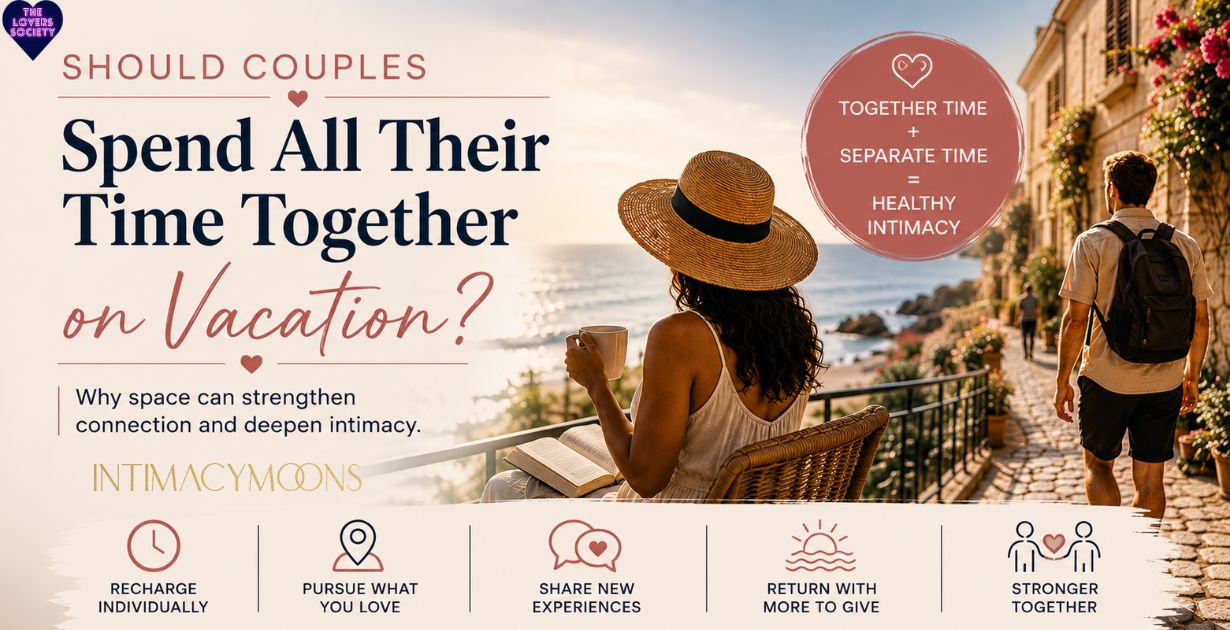
One of the biggest myths couples carry into vacation is the belief that a successful trip means spending every moment together.
Breakfast together.
Excursions together.
Pool time together.
Shopping together.
Dinner together.
Every minute.
Every day.
For some couples, that sounds romantic.
For others, it sounds exhausting.
The truth is that healthy relationships do not require constant togetherness. In fact, one of the healthiest things couples can do while traveling is give themselves permission to spend some time apart.
That may sound surprising, especially when you've invested significant time, money, and energy into creating an opportunity to reconnect.
But connection and autonomy are not competing needs.
They are both essential ingredients for lasting intimacy.
Many couples only get a few weeks each year away from work, responsibilities, and everyday demands.
By the time vacation arrives, there is often an unspoken expectation:
"We need to make the most of this."
That pressure can quickly turn into:
"We should spend every minute together."
For many couples, this belief comes from a good place.
You miss each other.
You want quality time.
You want connection.
You want to feel close.
But somewhere along the way, quality time becomes confused with constant proximity.
They are not the same thing.
Being beside each other all day does not automatically create connection.
And having a few hours apart does not automatically create distance.
As a couples therapist, I often work with partners who deeply love each other but have quietly lost themselves along the way.
Their schedules revolve around each other.
Their identities revolve around each other.
Their energy revolves around managing life together.
What often gets lost is individuality.
The hobbies they once enjoyed.
The interests they once pursued.
The parts of themselves that existed outside the relationship.
Many people assume intimacy means becoming one.
Healthy intimacy actually allows two whole people to remain connected while still maintaining a strong sense of self.
When couples lose that balance, attraction often begins to suffer.
Because desire thrives when there is both closeness and differentiation.
Differentiation simply means I can remain connected to you without losing myself.
That balance matters just as much on vacation as it does at home.
One of the most interesting things I see in long-term relationships is that absence often creates appreciation.
Not because partners need distance from each other.
But because space creates perspective.
Imagine one partner spends the morning at the spa while the other explores a local museum.
A few hours later they meet for lunch.
Now they have something to share.
Something to talk about.
Something they experienced independently.
Instead of spending the entire day moving through identical experiences, they bring fresh energy back into the relationship.
That curiosity often sparks deeper conversation.
And deeper conversation often sparks connection.
This is particularly important when we talk about intimacy.
One of the themes that comes up repeatedly in my work is that many couples unintentionally place enormous pressure on connection.
Pressure to be available.
Pressure to be present.
Pressure to perform.
Pressure to maximize every moment.
The challenge is that desire rarely flourishes under pressure.
Desire is not a task on a vacation itinerary.
It requires freedom.
It requires anticipation.
It requires space to notice your partner again.
Many couples discover that after spending a few hours doing separate activities, they return feeling more energized, more playful, and more interested in each other.
Not because they were disconnected.
Because they were able to reconnect from a place of choice rather than obligation.
As I often teach, intimacy is not something we hustle for. It grows when we create conditions that allow connection, curiosity, and pleasure to emerge naturally.
Another challenge couples encounter while traveling is assuming their partner should enjoy vacation the same way they do.
One partner may love adventure.
The other may crave rest.
One may want sightseeing.
The other may want silence.
One may enjoy social experiences.
The other may want solitude.
These differences are not relationship problems.
They are simply differences.
When couples stop viewing those differences as threats, they create room for both people to have a meaningful experience.
Healthy travel isn't about winning.
It's about honoring both people.
Personal space does not mean emotional withdrawal.
It does not mean avoiding your partner.
And it certainly does not mean living separate lives.
Healthy independence during travel might look like:
The goal is not separation.
The goal is balance.
Before your next trip, consider discussing these five questions:
These conversations reduce assumptions and increase understanding.
And understanding is often what creates the emotional safety couples are seeking in the first place.
I examine these questions in more detail in my article 5 Questions Every Couple Should Ask Before Traveling.
One of the greatest gifts you can give your relationship is permission.
Permission to be yourself.
Permission to have different needs.
Permission to recharge differently.
Permission to explore.
Permission to rest.
Permission to return to each other willingly and wholeheartedly.
The healthiest couples are not the ones who spend every second together.
They are the ones who understand that intimacy is not measured by proximity.
It's measured by the quality of connection they create when they come back together.
On your next vacation, ask yourself:
"What helps me feel most alive?"
Then ask your partner the same question.
You may discover that your answers are different.
That's not a problem to solve.
It's an invitation to know each other more deeply.
And sometimes, a few hours apart creates exactly the space needed to come home to each other again.
Travel & Relationships
couples vacation advice, healthy relationship boundaries, traveling with your partner, relationship autonomy, couples travel tips, connection and independence
Back to Blog