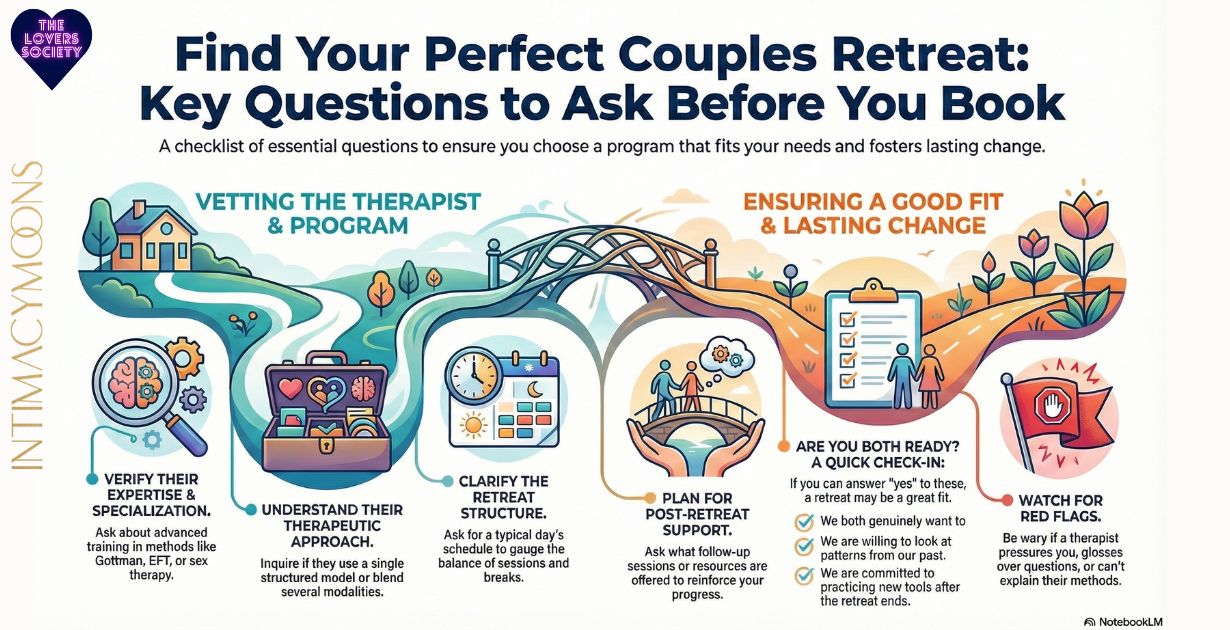
Why Questions Matter
Booking a couples therapy retreat is a significant investment of time, money and emotion. The consultation call is your opportunity to see if the therapist and program align with your relationship needs. By approaching this first conversation with curiosity and well‑crafted questions, you can ensure you’re choosing a retreat that promotes safety, trust and the growth you’re seeking. Asking thoughtful questions also sets the tone for a partnership where both you and the therapist share responsibility for your success.
Remember: the consultation is one piece of the puzzle. For a full five‑dimension decision framework, including the nature of your relationship needs, therapist expertise, retreat format, budget and timing, read our Ultimate Guide to Couples Therapy Retreats.
Getting Ready for the Consultation
- Clarify your goals. Before you call, take some time individually and as a couple to reflect on why you’re seeking a retreat and what you hope to achieve. Are you reconnecting after an affair, working through mismatched desire, or strengthening an already solid bond? Writing down your concerns and priorities will help you evaluate whether the therapist’s answers resonate.
- Consider format preferences. Are you looking for complete privacy, or would you benefit from hearing other couples’ perspectives? Private intensives provide undivided attention and confidentiality, while group settings offer shared learning and camaraderie. If you’re not sure which is right for you, browse our posts on Best Sex Therapy Retreats in the US for Couples and Black Couples Therapy Retreat Vacation Packages to explore different models.
- Know your budget and timeline. Retreats vary in length and cost. Have a sense of what you’re comfortable investing and when you can travel. If you’re still working out the details, our How to Book a Sex Therapy Retreat for Couples in 2026 offers a step‑by‑step planning guide.
Checklist of Questions to Ask
Use these categories as a checklist or scoring guide. For each section, rate how confident you feel after hearing the therapist’s answers on a scale of 1–5. The higher the score, the better the fit.
Credentials & Specialization
- What certifications or advanced training have you pursued specifically for working with couples? Ask about credentials in the Gottman Method, Emotionally Focused Therapy (EFT), Imago Relationship Therapy, Internal Family Systems or sex therapy. Invite the therapist to describe how these trainings influence the way they structure retreat sessions.
- How much of your practice is devoted to couples work? Therapists who regularly see couples have a deeper understanding of relational dynamics. It’s helpful to know what portion of their caseload involves couples and how that experience shapes their approach.
- Have you guided couples through challenges similar to ours? If you’re dealing with infidelity, mismatched desire or trauma, ask for examples of how they’ve supported couples with these issues. Hearing how they tailor interventions can reveal whether they’re equipped to meet your needs.
Therapeutic Approach & Philosophy
- Do you lean on a single framework or blend several? Some retreats follow a specific model, while others weave multiple modalities together. Invite the therapist to explain which elements they find most effective for couples in a retreat setting and why.
- How would you help us work through patterns rooted in our upbringing? Deeper healing often requires exploring childhood experiences and family dynamics. Find out whether the therapist incorporates this work and how it fits into the flow of the retreat.
- How do you define and measure success? Ask what progress looks like in their eyes. Do they focus on improved communication, renewed intimacy or reduced conflict? Find out how they track change during and after the retreat to ensure you’re making meaningful strides.
Retreat Structure & Format
- Can you walk us through a typical retreat day? Intensives can range from three hours of sessions with ample breaks to eight hours of therapy per day. Ask about the balance between sessions, reflection time and recreational activities so you can assess whether the pace will feel supportive or overwhelming.
- Do you host only one couple at a time, or are there opportunities to learn alongside other couples? The dynamic of a private retreat is very different from a small group experience. Understanding the setting helps you choose what will make you most comfortable and engaged.
- How is downtime for integration built into the itinerary? Retreats are most effective when there’s space to process and practice new skills. Ask how they schedule quiet time or unstructured activities to help you absorb insights before moving on.
Goals, Outcomes & Post‑Retreat Support
- Will we leave with a personalized roadmap? A good retreat doesn’t end when you check out. Ask whether the therapist provides written notes, exercises or a plan tailored to your relationship so you can continue the work at home.
- What follow‑up support do you offer once the retreat ends? Some programs include check‑in calls, additional sessions or a community forum. Clarify what kind of ongoing support is available to reinforce your progress.
- How do you evaluate success and gather feedback from past participants? Therapists should be able to explain how they gauge progress, whether through self‑assessments, surveys or follow‑up sessions, and share typical improvements couples experience after attending their retreats.
Differences From Weekly Therapy & Fit
- How does the immersive retreat experience differ from weekly therapy? Intensive retreats offer concentrated time to stay in the work long enough to break through defensive patterns. Ask how the therapist uses this longer format to help you move through multiple layers of issues.
- What strategies help us carry momentum back into everyday life? Breakthroughs won’t last without support. Ask about homework, ongoing practices or digital resources designed to help you integrate what you learn when you return home.
- Why might an intensive be the right investment for us now? Invite the therapist to share the unique benefits they’ve observed in retreat participants compared to those who only attend weekly sessions. Look for tangible reasons such as accelerated breakthroughs, deeper insight or renewed motivation, that feel relevant to your situation.
Compatibility & Red Flags
- Notice how you feel during the consultation. After the call, reflect on whether both partners felt heard, understood and respected. A strong therapeutic relationship is built on trust and neutrality; neither partner should feel shamed or sidelined.
- Watch for red flags. Be cautious if the provider glosses over your questions, insists their program works for everyone, pressures you to sign up immediately or cannot clearly explain their methods and aftercare. A therapist who tailors their approach and respects your decision‑making process is key to a positive experience.
Self‑Check: Are You Ready for a Couples Therapy Retreat?
Use this short assessment to decide whether an intensive format fits you right now. Answer “yes” or “no” to each statement:
- We both genuinely want to strengthen our relationship, even if we don’t yet know how.
- We’re prepared to clear our schedules for at least two full days of concentrated work and reflection.
- We’re willing to look at patterns from our past as well as current challenges.
- We’re committed to practising new tools and habits after the retreat ends.
- We recognise that lasting change requires ongoing effort rather than a single event.
If you answered “yes” to most statements, an immersive retreat may be a transformative next step. If you answered mostly “no,” you might start with a shorter workshop, online course or local counselling—see our posts on Black Couples Therapy Retreat Vacation Packages and Best Sex Therapy Retreats in the US for Couples for alternative formats and pacing.
Conclusion
Your consultation call is your first chance to gauge whether a couples therapy retreat is the right fit. By preparing thoughtfully, asking unique, insightful questions and paying attention to how you feel during the conversation, you’ll be better equipped to choose a therapist and program that align with your relationship’s needs. Use the checklist and self‑check above as guides, but remember they’re only part of your decision. For a comprehensive evaluation across all five dimensions—needs, expertise, format, budget and timing—turn to our Ultimate Guide to Couples Therapy Retreats. When you invest time in finding the right match, you set yourselves up for deeper healing and a more connected partnership.
If you’re craving more connection, more clarity, and more real talk, start here:
👉 The Lovers Society Podcast
questions to ask couples retreat therapist, couples retreat consultation checklist, choose couples therapy retreat, therapist interview couples retreat, self‑check couples therapy retreat