- couples therapy retreats
- RETREAT THEMES
- COURSES
- TRAVEL CONCIERGE
- Blog
- Press


If you are considering a couples or intimacy retreat, you are likely not doing so casually.
Most couples reach this point after months or years of feeling stuck. Desire may have faded or become tense. Intimacy might feel emotionally charged,awkward, or avoided altogether. One partner may feel rejected while the other feels pressured or misunderstood. Often, shame sits quietly underneath it all.
Because a sex therapy retreat is immersive, vulnerable, and often high-investment financially and emotionally, vetting the therapist leading itis even more important than in traditional weekly therapy.
I have worked with many couples who came to me after working with the wrong “sex expert” in a retreat, workshop, or coaching setting. Not because theperson lacked confidence or intention, but because sexual openness and personal experience are frequently mistaken for clinical expertise.
Knowing how to vet a sex therapist before booking a retreat can make the difference between a transformational experience and one that leaves youfeeling exposed, pressured, or further disconnected.
We also did full write ups on The Best Sex Therapy Retreats in the US as well as How to Book a Sex Therapy Retreat so you could get your research done in the most efficient manner possible.
A retreat places you in extended sessions, often multiple hours at a time, where intimacy, communication, and sexuality are explored in depth. There is little room for error when it comes to training, ethics, pacing, and emotional safety.
Unlike traditional therapy, you are not just testing fit over time. You are placing a great deal of trust in advance. That makes vetting essential.
Many couples assume that if someone is confident talking about sex, they are qualified to guide them through deeply personal material. Unfortunately, hat assumption can lead to experiences that feel overwhelming rather than healing.
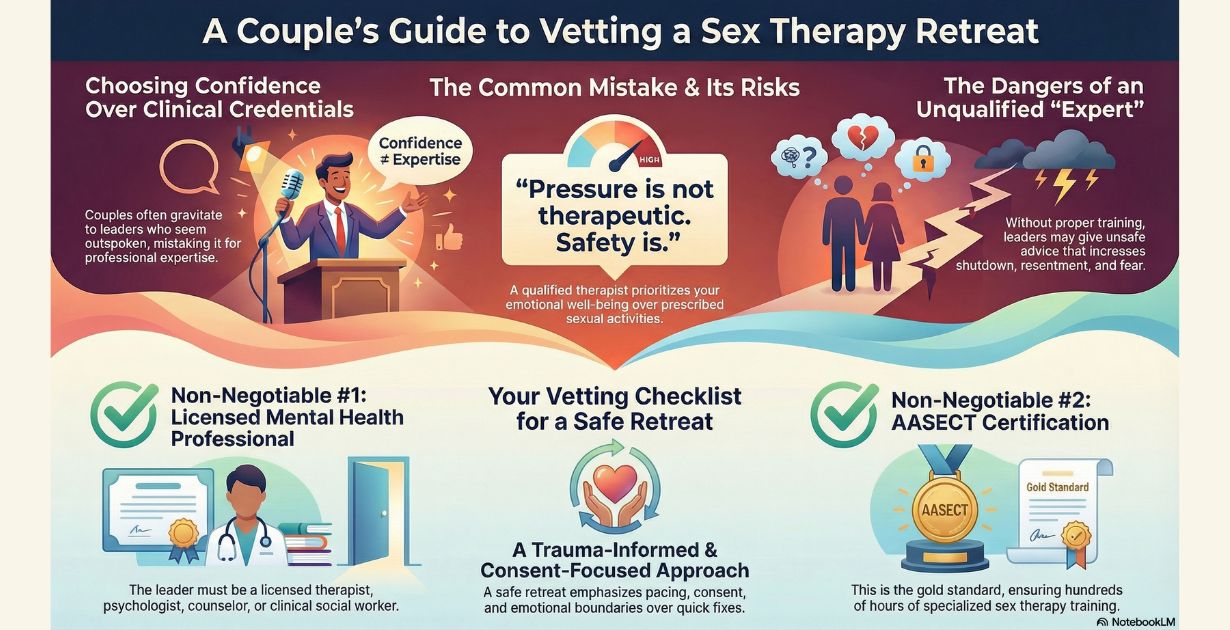
The biggest mistake couples make is choosing a retreat leader based solely on how comfortable or outspoken they seem about sex.
People who feel shy, anxious, or uncertain about intimacy often gravitate toward someone who appears confident and uninhibited. That confidence can bereassuring. But confidence alone does not mean the person understands trauma, attachment, desire discrepancy, betrayal, or nervous system regulation.
In some cases, couples end up guided by individuals who are relying primarily on personal experience rather than formal clinical training. Others discover too late that the person leading the retreat is not licensed, not regulated, and not accountable to a professional governing body.
When that happens, advice can quickly become prescriptive, value-driven, or even unsafe.
At a minimum, the lead therapist should be a licensed mental health professional. This may include a Licensed Marriage and Family Therapist, psychologist, licensed professional counselor, or clinical social worker. The key requirement is licensure and experience working with couples and relational dynamics.
For sex therapy specifically, AASECT certification is critical.
AASECT certification requires extensive training in sexual health, supervised clinical experience, continuing education, and adherence to a professional code of ethics. Most general therapists receive little formal training in sexuality. AASECT-certified sex therapists receive hundreds ofadditional hours focused specifically on desire, arousal, sexual functioning, trauma, consent, and relational intimacy.
If someone is offering a sex therapy retreat without this level of training, that is an important signal to pause.
I have worked with couples who arrived after attending retreats or workshops where they were told that the way they were having sex was wrong or that they needed to push past discomfort to fix their intimacy.
In one case, a couple recovering from betrayal was encouraged to introduce sex toys and novelty before rebuilding safety and trust. In another, partners with mismatched desires were urged toward more intense forms of intimacy without space to explore trauma histories or emotional boundaries.
In both situations, the result was not closeness, but increased shutdown, resentment, and fear.
Depth work around sexuality requires skill, restraint, and attunement.When those elements are missing, retreats can unintentionally recreate harminstead of repair.
When couples transitioned into work led by a trained sex therapist, the focus shifted away from performance and toward understanding.
Instead of being told what to do in the bedroom, couples explored what sex meant to each of them. They examined how stress, resentment, trauma, and unmet emotional needs were playing out sexually. They learned how to communicate boundaries and desires without blame or pressure.
Over time, intimacy became something they co-created with safety and curiosity, not something they tried to force.
That is what effective sex therapy retreat work looks like.
Before committing to a retreat, ask the therapist leading it to walk you through how they would approach a couple with challenges similar to yours. Youdo not need to disclose everything, but sharing some context and listening to how they respond can be very revealing.
Pay attention to whether they emphasize pacing, consent, emotional safety, and relational dynamics rather than quick fixes or prescribed activities.
A thoughtful answer will sound grounded and nuanced. Overconfidence or rigid prescriptions are signs to slow down.
Be cautious if a retreat leader pushes sexual activities regardless of readiness, minimizes discomfort, avoids discussing trauma or betrayal, or frames desire discrepancy as one partner’s problem.
Pressure is not therapeutic. Safety is.
A high-quality retreat supports emotional closeness as much as sexual connection. Over time, couples should experience better communication, less pressure, greater curiosity, and a renewed sense of partnership both inside and outside the bedroom.
Sex becomes less about obligation and more about mutual exploration.
Non-negotiable criteria include licensure as a mental health professional, extensive training in sex therapy, ideally with AASECT certification, a trauma-informed approach, and clear respect for boundaries, consent, and pacing.
Helpful but optional elements include attachment-based training, experience working with long-term couples, and familiarity with desire discrepancy, betrayal recovery, and mismatched sexual histories.
Booking a sex therapy retreat is a courageous step. It requires trust, vulnerability, and investment.
You do not need someone who simply sounds comfortable talking about sex.You need someone trained to hold complexity, emotional safety, and desire atthe same time.
Knowing how to vet a sex therapist helps ensure your retreat experience heals rather than harms, and supports the kind of intimacy that lasts well beyond the retreat itself.
Ready to explore your options? Listen to The Lovers Society Podcast wherever you get your podcasts or reach out to IntimacyMoons to learn more about our private sex therapy retreats, online intensives, and Lovers Society community. We’re here to answer your questions, support your booking process, and help you create the intimate, joyful relationship you deserve.
Sex Therapy
sex therapy retreat, how to choose a sex therapist, couples sex therapy
Back to Blog