- couples therapy retreats
- RETREAT THEMES
- COURSES
- TRAVEL CONCIERGE
- Blog
- Press


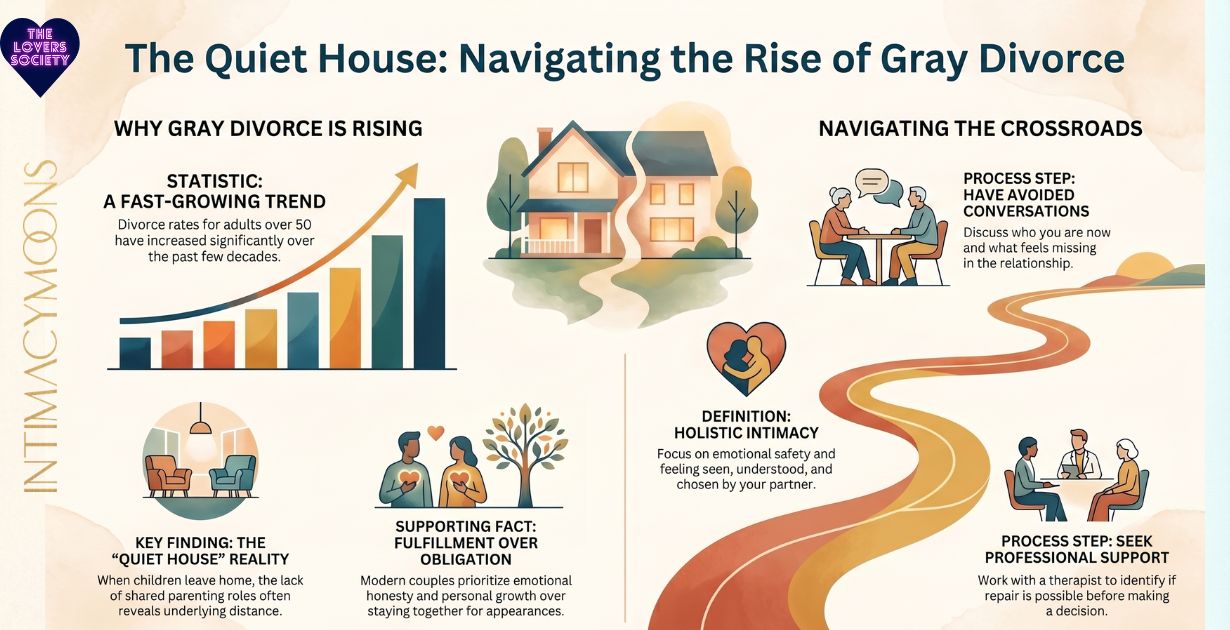
Gray divorce is increasing as couples over 50 navigate major life transitions, identity shifts, and evolving relationship needs. More people are choosing whether to stay or leave based on fulfillment instead of obligation.
There is a moment many couples do not expect.
The house becomes quiet. The kids are gone, building lives of their own. The routines that once structured your days begin to shift. And in that stillness, something else becomes clear.
You look at your partner and wonder, who are we now?
For years, sometimes decades, your relationship may have revolved around parenting, responsibilities, and simply getting through daily life. When those roles begin to fall away, what remains can feel unfamiliar.
For some couples, this moment creates space for reconnection.
For others, it reveals a distance that has been quietly growing for years.
This is often where gray divorce begins.
Gray divorce refers to couples over the age of 50 choosing to end their marriage. Once considered rare, it is now one of the fastest growing divorce trends in the United States.
According to the American Psychological Association, divorce rates among adults over 50 have increased significantly over the past few decades.
Part of this shift is cultural.
In earlier generations, many couples stayed together regardless of their emotional reality. Divorce carried a heavier stigma, and relationships were often maintained for stability, appearances, or obligation.
Today, people are asking different questions.
Does this relationship still feel meaningful?
Am I fulfilled here?
More individuals are allowing the answers to guide their decisions.
This is not just about endings. It is about awareness.
When children leave home, couples often lose the central role that once bonded them. Parenting created structure, purpose, and connection.
Without it, underlying disconnection can surface quickly. What once felt like partnership may begin to feel like coexistence.
This is one of the most powerful and uncomfortable questions couples face in midlife.
Over time, people grow and evolve. That growth does not always happen in the same direction.
Without intentional reconnection, couples may realize they no longer know each other in the ways they once did.
Many couples in this stage are navigating multiple layers of responsibility.
They may be supporting adult children while also caring for aging parents. At the same time, they are managing their own health and life transitions.
This emotional and physical load can lead to burnout, leaving little energy for nurturing the relationship.
👉 Related read: Emotional Safety & Communication
People do not stay the same, and relationships do not stay the same either.
What you wanted at 30 can look very different at 55.
Sometimes one partner evolves more rapidly or in a different direction. This can create a gap that feels difficult to close.
Midlife brings real changes.
Hormonal shifts, sexual health concerns, and changes in desire can all impact connection. These experiences are not just physical. They are deeply emotional.
When they are not discussed openly, they can create distance and misunderstanding.
The The Gottman Institute highlights how emotional and physical intimacy are closely connected. When one is strained, the other often is as well.
Infidelity can also play a role in gray divorce.
For some couples, it becomes a breaking point.
For others, it reflects deeper unmet needs or long-standing disconnection.
👉 Related read: Intimacy After Infidelity
In the past, many couples stayed together even when the relationship had emotionally ended.
They attended events together, maintained appearances, and lived separate lives behind closed doors.
Today, there is a shift toward intentional living.
People are less willing to remain in relationships that feel empty or disconnected.
Instead, they are making conscious decisions to stay and rebuild or to leave and begin again.
Staying from obligation feels very different than staying from desire.
Sometimes the desire to leave points to something important.
Chronic emotional disconnection, unresolved betrayal, and persistent loneliness within the relationship should not be ignored.
At the same time, this stage of life can be an opportunity.
It can be a chance to relearn each other, rebuild intimacy, and redefine the relationship with intention.
According to the American Association for Marriage and Family Therapy, many couples can restore connection when they have the right support and tools.
👉 Related read: Couples Therapy Retreats
Before deciding whether to stay or go, it is important to slow things down.
Talk about who you are now, what you need, and what feels missing.
These conversations may feel uncomfortable, but they are necessary.
Intimacy is not just about sex.
It is about feeling seen, understood, and chosen.
Rebuilding that connection often starts with emotional safety.
You do not have to navigate this alone.
Working with a trained therapist can help you understand what is happening beneath the surface, identify whether repair is possible, and move forward with clarity.
If you are questioning whether to stay or go, you do not have to figure that out on your own.
Gray divorce reflects a larger cultural shift.
People are prioritizing emotional honesty, personal fulfillment, and authentic relationships.
For some couples, that means parting ways.
For others, it means rebuilding something stronger than what existed before.
In both cases, the goal is the same.
To live and love with intention.
If you find yourself at this crossroads, know this.
You are not alone.
And this moment does not need to be rushed.
Sometimes the question is not simply whether you should stay together.
It is whether there is something here worth rediscovering.
If this resonated with you, the next step is to hear it in real time. Tune into
Emotional Safety & Communication
divorce after 50, empty nest marriage problems, long-term marriage issues, midlife relationship changes, why couples grow apart
Back to Blog